Open Nav



Every electronics company eventually faces the same decision: should we keep PCB assembly in-house or outsource to a contract manufacturer? The answer isn't always obvious. Building a business case requires more than comparing quotes—it demands a thorough understanding of the total cost of ownership, hidden expenses, and the strategic value that outsourcing can deliver.
This guide walks you through how to calculate the return on investment (ROI) of outsourcing your PCB assembly, step by step. By the end, you'll have a framework for making an informed decision based on real numbers rather than assumptions.
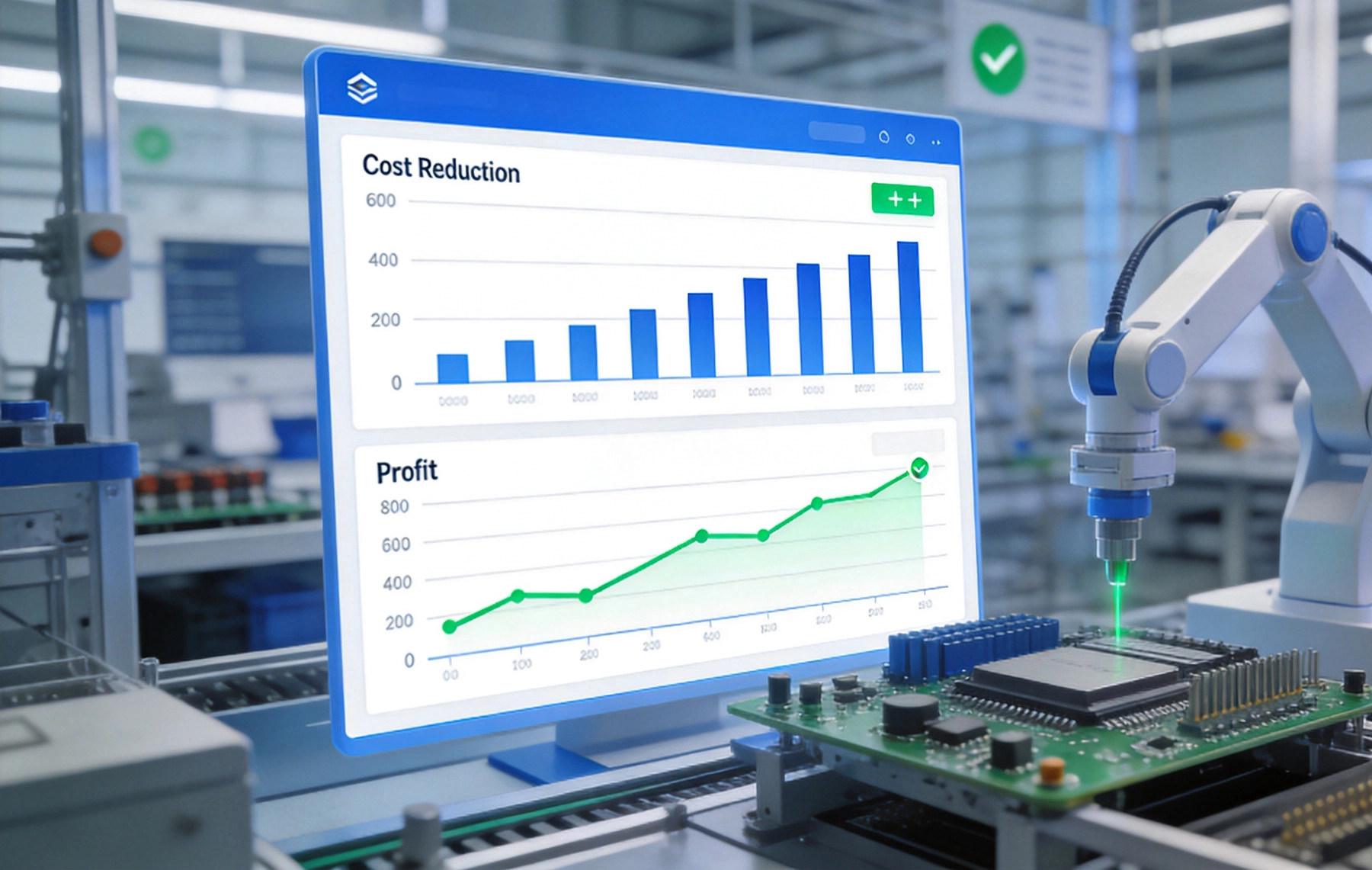
Before you can calculate the ROI of outsourcing, you need a clear picture of what you're currently spending. Most companies underestimate their in-house costs because they don't account for all the components that add to the total cost of ownership.
Beyond the obvious line items, several hidden costs quietly erode your profitability:
Contract manufacturers specialize in assembly. They've invested in the latest equipment, developed optimized processes, and built expertise that comes from running the same operations thousands of times. This specialization creates value in several ways.
A CM running 10,000 boards per day spreads their fixed costs across far more units than your facility running 500 boards per week. This translates directly into lower per-unit costs for you. Additionally, CMs purchase components in massive volumes, earning discounts that get passed along to customers.
Outsourcing converts capital expenditure (equipment, facilities) into operating expenditure (per-unit costs). This improves your balance sheet and frees up cash for strategic investments in R&D, marketing, or other areas where you have competitive advantage.
Need to ramp up production for a seasonal product? A good CM can absorb the surge without requiring you to hire and train temporary workers. Planning to launch a new product line? The CM can scale capacity up or down based on actual market demand, reducing the risk of overproducing.
Specialized CMs invest continuously in the latest equipment and process improvements. When you outsource, you gain access to these capabilities without bearing the full cost. Whether you need advanced AOI inspection, X-ray testing for BGAs, or expertise with lead-free soldering, your CM has already made the investment.
Now let's get into the numbers. A proper ROI calculation compares your total in-house cost against the total outsourced cost, accounting for both direct expenses and the softer factors that affect profitability.
Start by determining what each assembled board actually costs you to produce in-house. Use this formula:
Total In-House Cost = (Annual Fixed Costs + Annual Variable Costs) ÷ Annual Volume
Where:
Be thorough. Many companies exclude items that legitimately belong in the calculation. If you're not sure whether to include something, ask yourself: "Would this cost disappear if we stopped assembling boards?" If the answer is no, it's a fixed cost you should include.
Request quotes from potential CM partners. Make sure you're comparing apples to apples:
Once you have a comprehensive quote, calculate your total annual outsourced cost at your expected production volume.
This is where many ROI analyses fall short. The benefits of outsourcing go beyond the direct cost comparison. Assign dollar values to these factors:
Estimate how many hours your engineers currently spend on manufacturing-related activities: troubleshooting production issues, optimizing assembly processes, managing supplier relationships, and handling quality problems. Multiply those hours by fully-loaded engineering cost. Now imagine those hours redirected to product development.
Example: If two engineers spend 20% of their time on manufacturing issues, and each costs $100,000 annually (including benefits), that's $40,000 per year in redirected engineering capacity.
Outsourcing with a responsive CM can reduce your inventory requirements. You order what you need, when you need it, rather than building buffer stock to cover long lead times. Calculate your inventory reduction and multiply by your carrying cost rate (typically 20-30% of inventory value annually).
Track your current costs of quality failures: scrap, rework, warranty returns, customer complaints, and the time spent investigating and resolving issues. CMs with mature quality systems typically achieve lower defect rates, which translates directly into cost savings.
When you can get products to market faster, you capture revenue earlier and establish competitive advantage. Estimate the revenue impact of reducing your production lead time by a certain number of weeks. Even a rough calculation helps quantify this benefit.
Now pull it all together:
Annual Savings = (In-House Cost - Outsourced Cost) + Quantified Benefits
ROI = (Annual Savings - Annual Outsourcing Fee) ÷ Annual Outsourcing Fee × 100%
Or, if you prefer a payback period approach:
Payback Period = Implementation Costs ÷ Annual Net Savings
Let's look at a hypothetical case that illustrates how these calculations work in practice.
Company X manufactures industrial control modules. They currently assemble 5,000 boards per year in-house, with the following cost structure:
Total annual in-house cost: $378,000
Cost per board: $75.60
A qualified CM quotes $68 per board for the same assembly, including materials. Total outsourced cost: $340,000.
But wait—there's more. The company estimates:
Net annual savings: $378,000 - $340,000 + $30,000 + $8,000 + $4,500 = $80,500
ROI on outsourcing: $80,500 ÷ $340,000 = 23.7%
In this example, outsourcing delivers substantial savings while freeing up resources for higher-value activities.
Every company's situation is different. Several factors influence whether outsourcing will deliver positive ROI for your specific context.
Volume has a significant impact on the economics. Low-volume producers (under 1,000 units/year) almost always benefit from outsourcing because fixed costs are spread across too few units. High-volume producers (over 50,000 units/year) may find in-house economics improve, but they should still evaluate whether their capital is deployed optimally.
Standard products with common components and mature processes are easier to outsource and yield better ROI. Complex products with unusual requirements may involve higher CM setup costs that affect the calculation.
Shipping costs and lead times factor into the total cost of outsourcing. If your products are bulky or heavy, transportation costs may erode some savings. Time zone differences can also affect communication and project management efficiency.
The CM you choose matters enormously. A responsive, communicative partner who proactively flags issues delivers more value than one who just executes orders. When evaluating ROI, consider the quality dimension—cheapest isn't always best if it comes with hidden costs from poor service.
Outsourcing isn't without risks. A thorough analysis acknowledges these and considers how to mitigate them.
When you outsource, you depend on another organization for a critical function. Quality issues, delivery delays, or communication problems are more difficult to address when you're not on-site. Mitigation strategies include choosing reputable partners, establishing clear quality agreements, and maintaining visibility through regular reporting.
Sharing your designs with a third party creates IP risk. Reputable CMs protect client information and sign NDAs. Due diligence on potential partners should include review of their IP protection practices.
Adding a supply chain node adds complexity. Your CM's ability to source components, manage their own suppliers, and handle disruptions affects your delivery reliability. Evaluate their supply chain resilience as part of your selection process.
Outsourcing costs may increase over time due to inflation, capacity constraints, or changing market conditions. Build flexibility into your agreements with clear pricing mechanisms and the option to adjust volumes based on actual demand.
If your analysis shows positive ROI, the transition process itself requires careful management to protect the benefits you've calculated.
Don't migrate everything at once. Begin with a subset of products or production volume to validate the CM's capabilities and iron out any process issues. This reduces risk and gives you data to refine your projections.
The quality of your handover documentation directly affects the transition success. Provide comprehensive specifications, test procedures, quality requirements, and any special handling instructions. This investment pays dividends in smoother production and fewer issues.
Some companies retain minimal in-house capability for rapid prototyping, emergency production, or specialized requirements that aren't cost-effective to outsource. This hybrid approach captures most of the outsourcing benefits while retaining flexibility.
Calculating the ROI of outsourcing PCB assembly requires rigor, but the effort pays off with a decision based on facts rather than assumptions. By understanding your true total cost of ownership, quantifying hidden benefits, and carefully selecting your manufacturing partner, outsourcing can deliver substantial improvements to your bottom line and strategic positioning.
The key is to approach the analysis with an open mind. Whether the numbers point toward outsourcing, staying in-house, or a hybrid approach, you'll have the evidence to justify your decision—and that's how sound business strategy works.
Most companies begin seeing financial benefits within 3-6 months of transitioning production. The exact timeline depends on transition complexity, volume ramp-up, and how quickly you can redeploy internal resources to higher-value activities.
There's no universal threshold, but volumes below 500-1,000 units per year almost always favor outsourcing due to the high fixed cost burden of in-house production. Above that range, run the numbers based on your specific cost structure.
Evaluate CMs based on technical capabilities (do they handle your specific requirements?), quality systems (certifications, inspection processes), communication practices (responsive, clear, proactive), and cultural fit (do they understand your industry and business?). Request samples and references before committing.
Key elements include detailed specifications and acceptance criteria, quality requirements and defect thresholds, pricing structure and volume commitments, lead time expectations, IP protection clauses, and escalation procedures for quality or delivery issues.
Use NDAs, limit disclosure to essential information only, work with CMs that have established IP protection practices, and consider splitting production across multiple partners for highly sensitive products. Due diligence on security practices is essential.
Ready to calculate your potential savings from PCB assembly outsourcing? Our team can help you build a comprehensive ROI analysis tailored to your specific situation.
Understanding PCBA: The Core of Modern Electronics ManufacturingAugust/08/2026
How We Source Hard-to-Find Components for Your PCBA Projects?July/07/2026

What Are the Benefits of Small Batch PCB Assembly?May/18/2026
How Flexible Are Low Volume PCB Assembly Manufacturers?May/18/2026
How Does Turnkey PCB Assembly Work? From BOM to Box BuildJune/29/2026