Open Nav



You built a solid circuit board. The design is clean, the components are quality, and your assembly house did a great job with the paste and reflow. But then you learn it's going into an automotive under-hood application, or maybe an outdoor sensor that has to survive tropical humidity, or an industrial control box where chemicals are just part of the daily atmosphere. That's when you start thinking about conformal coating.
Conformal coating is basically a protective layer that conforms to the shape of your assembled PCB, covering the components, traces, and solder joints with a thin film of protective material. It isn't encapsulation—you're not potting the whole assembly in thick plastic. Instead, you're applying something that follows the topography of the board, typically 25 to 200 microns thick, adding protection without significantly changing the physical characteristics of your circuit.
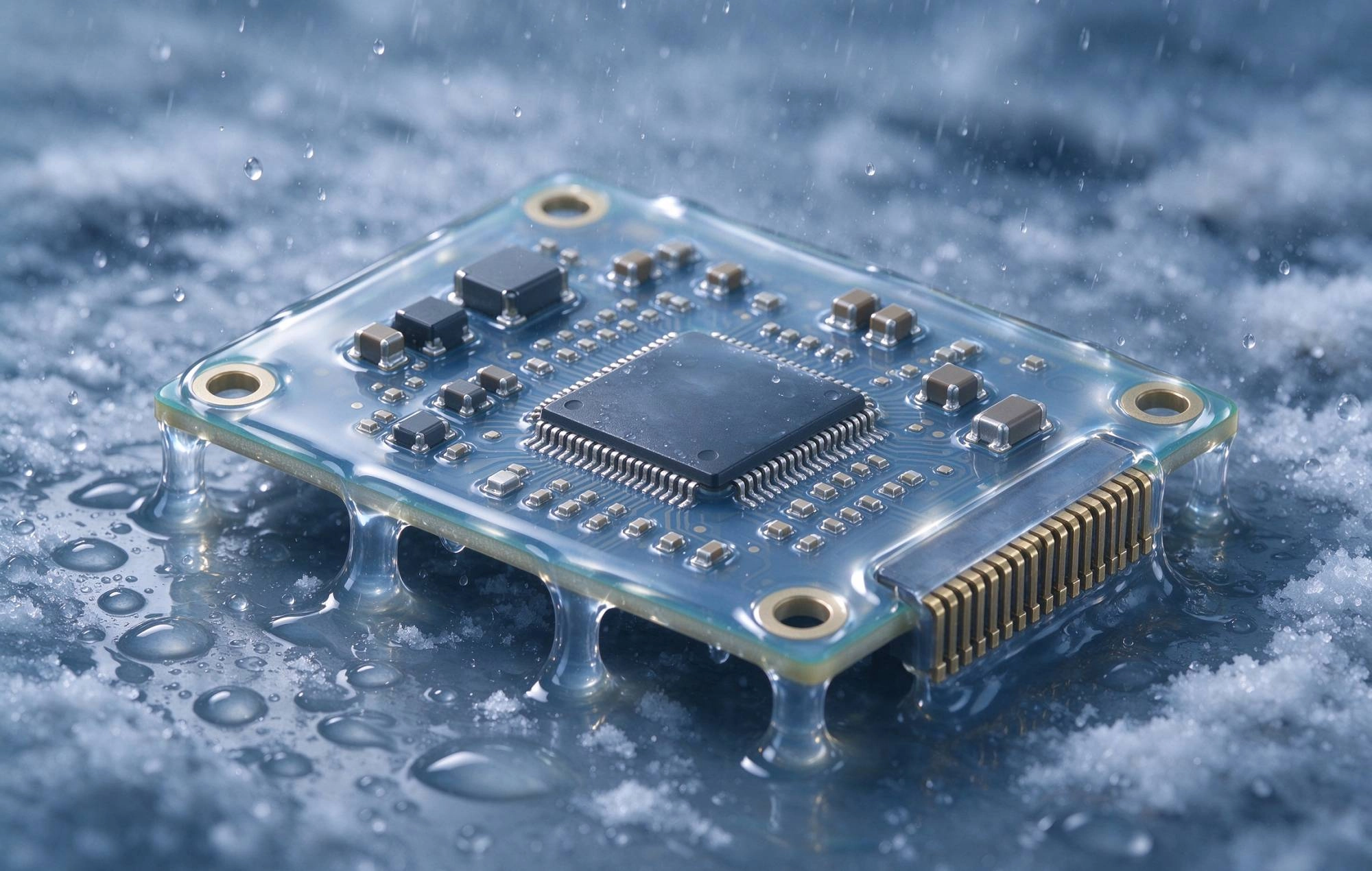
The enemies of electronics are everywhere once you move beyond a clean, climate-controlled environment. Moisture is public enemy number one for most assemblies. Even boards that pass humidity testing can develop dendritic growth between closely spaced leads over time, especially when driven by voltage. Conformal coating interrupts that process by creating a barrier that keeps moisture away from the metal surfaces.
Dust and debris matter too, especially in industrial settings. A board sitting in a factory floor enclosure might look fine visually, but over months or years, conductive particles can settle on the surface and cause leakage currents or干脆 shorts. The coating seals everything under a protective barrier.
Chemical exposure is another consideration. Some applications expose boards to solvents, fuels, salts, or other aggressive substances. Without protection, the solder mask degrades, traces corrode, and your board fails prematurely. The right conformal coating acts as a chemical barrier that extends the operational life dramatically.
Thermal cycling stress gets reduced by conformal coating as well. When a board goes through temperature extremes, the different expansion rates of components, solder, and substrate create mechanical stress. The coating helps buffer these stresses and can prevent crack propagation in solder joints over thermal cycling.
Not all conformal coatings are created equal, and choosing the right one for your application is important. Each type has strengths and limitations that make it better suited for certain environments.
Acrylic conformal coatings are probably the most commonly used type in general applications. They offer good moisture protection, are relatively easy to apply and remove, and cure quickly. Most acrylic coatings can be removed with standard solvents if rework is needed, which is a huge advantage during manufacturing and maintenance.
The downside is that acrylics generally don't hold up well against aggressive chemicals or solvents. If your board might encounter fuel, certain cleaning agents, or industrial solvents, acrylic probably isn't your best choice. But for consumer electronics, automotive under-dash applications, and general industrial use, acrylic coatings do the job reliably.
Silicone conformal coatings excel in high-temperature environments. While most coatings handle temperatures up to around 125°C or 150°C comfortably, silicone coatings can take 200°C or more without degrading. If your board will be operating near heat sources or in hot environments, silicone is worth considering.
Silicone coatings are flexible even when cured, which makes them good for boards that experience vibration or thermal cycling. The flexibility helps prevent cracking that might occur with harder coatings. However, silicone is notoriously difficult to remove completely, which can complicate rework and repair. The slightly tacky surface can also attract dust in some environments.
Urethane coatings provide excellent chemical resistance, which makes them popular for boards that will be exposed to fuels, oils, or industrial solvents. If you're designing for automotive fuel systems or industrial equipment with chemical exposure, urethane should be on your shortlist.
The trade-off is that urethane coatings are more challenging to apply and even more difficult to remove than other types. Repairing a urethane-coated board often means cutting away the coating rather than dissolving it, which can be destructive to the underlying components and traces.
Epoxy conformal coatings form an extremely hard, durable barrier. They're great for mechanical protection and chemical resistance, but that hardness comes at a cost—epoxy coatings are rigid and can crack under thermal cycling or mechanical stress. They're best suited for applications where the board won't see much temperature variation after coating.
Like urethane, epoxies are difficult to remove once cured. The application process also requires careful mixing of multi-part systems, and pot life becomes a factor in manufacturing planning.
Parylene is a unique conformal coating that gets applied through vapor deposition rather than liquid application. The process happens in a vacuum chamber where the parylene dimer is vaporized and polymerizes on the board surface, creating an extremely uniform coating with no pinholes or voids.
This makes parylene exceptionally good for boards that need maximum protection in miniature packages or with very fine pitch components. The coating follows every contour perfectly because it literally grows from a gas onto the surface. The drawbacks are cost—the deposition process is expensive—and the fact that parylene cannot be easily removed or reworked in the field.
How you apply the coating matters almost as much as which coating you choose. Different methods suit different production volumes and quality requirements.
Brushing is the simplest method and might make sense for low-volume production or prototype boards. The challenge is getting consistent thickness and avoiding air bubbles or brush marks that could create weak spots. It's also hard to apply coating only where you want it without masking off other areas.
Aerosol spray cans work for small-scale coating, but for production volumes, dedicated spray equipment gives better results. Spray application allows for good thickness control and reasonable coverage uniformity. You'll typically need masking to protect connectors, switches, and any areas where coating would interfere with function or appearance.
Dipping provides the most thorough coverage for boards that can tolerate coating on all surfaces including the bottom. The board gets lowered into a tank of coating material and then withdrawn at a controlled speed. Withdrawal speed directly affects coating thickness, so process control is important.
Dipping works well for high-volume production but requires good masking for any areas that must stay clean. Connectors, potentiometer shafts, and any components that need to move or make contact need protection before dipping.
As mentioned earlier, vapor deposition is the method for parylene coatings. It requires specialized equipment and typically gets done by dedicated coating service providers rather than in-house for most manufacturers. The excellent coverage and uniformity make it worth considering for high-reliability applications.
Thinking about conformal coating should start during the initial PCB design phase, not as an afterthought once the board is complete. Several design decisions affect how well coating will work for your application.
Component spacing matters more than you might expect. Components that are too close together can trap coating material and create voids or uneven coverage. A little extra space between tall components and their neighbors gives the coating material room to flow and settle properly.
Keep-out areas need to be clearly marked and considered during layout. Connectors, heat sinks, moving parts, and any surface that shouldn't be coated need to be designed with coating in mind. Some designers add dedicated coating barriers to the board layout that make masking easier.
Via handling is worth planning ahead. Bare vias under components can potentially trap coating material and cause problems. If you have high-reliability requirements, consider tenting or plugging vias that might cause issues. The extra cost of covered vias is often worthwhile for the reliability improvement.
Whatever application method you choose, proper masking is essential for quality results. The things that absolutely cannot have coating include connectors that need to make electrical contact, screw holes that need to accept fasteners, adjustment controls that require physical access, and any areas where coating thickness would interfere with assembly or function.
Masking methods range from hand-applied tape for prototypes to custom-molded masks for production. Some manufacturers use liquid mask materials that get applied, then peeled away after coating. The right approach depends on your production volume and the precision required.
One common mistake is not accounting for coating wicking under the mask edge. Liquid coatings can creep under tape edges, especially if application isn't careful. Better-quality masking systems account for this and specify how much overlap you need to ensure clean edges.
Checking coating quality isn't as simple as visual inspection, though visual checks are a good start. You're looking for complete coverage, consistent thickness, and absence of defects like bubbles, pinholes, or peeling.
Thickness measurement is important because coating that's too thin won't provide adequate protection, while coating that's too thick might interfere with heat dissipation or component clearance. Many manufacturers use eddy current meters to measure coating thickness non-destructively on representative samples.
For high-reliability applications, more rigorous testing might be appropriate. This could include抽查 samples that get cross-sectioned to verify coating integrity, or environmental testing of coated boards to verify protection effectiveness under simulated harsh conditions.
The most frequent coating problems I see in practice come from a handful of recurring mistakes. Applying coating over contamination is near the top of the list. Any flux residue, oil, or surface contamination will prevent proper coating adhesion and create weak points in the protection. Cleaning before coating isn't optional—it's essential.
Rushing the cure cycle causes problems too. Most coatings need adequate time at the right temperature to fully cure and reach their intended protective properties. Boards that get handled too soon or placed in service before cure is complete might not have the chemical resistance or mechanical properties the specification requires.
Inconsistent thickness from poor process control shows up especially on boards with varied topography. Areas under tall components or in deep crevices between parts might get thinner coating than exposed flat areas. Adjusting application parameters for your specific board design helps avoid this.
Eventually, a component on a coated board might fail and need replacement. How easy or difficult this is depends heavily on the coating type and how the original application was done.
Acrylic coatings are the most rework-friendly because they dissolve in common solvents. The rework technician can carefully remove coating from the affected area, replace the component, and reapply coating locally. It's not trivial, but it's manageable.
Silicone and urethane coatings are more challenging. They might require mechanical removal with scraping or cutting tools, which risks damaging traces or nearby components. For these coatings, the rework procedure needs to be well-defined and performed by technicians who know what they're doing.
Parylene is essentially impossible to remove locally. Failed boards with parylene coating often get completely recoated after component replacement, which adds significant cost to the rework process.
Choosing a conformal coating involves balancing multiple factors: the environment your board will operate in, the required reliability level, your budget constraints, and how reworkability affects your maintenance strategy.
For most applications, starting with acrylic is reasonable—it offers good all-around protection and maximum flexibility for rework. If your application has specific challenges like high temperatures, chemical exposure, or extreme miniaturization, look at the more specialized coating types that address those specific needs.
When in doubt, talk to coating material suppliers and coating service providers. They have experience across many applications and can often point you toward solutions that have worked well for boards similar to yours. The cost of a consultation is trivial compared to the cost of field failures.
Conformal coating is a proven method for extending the operational life of electronic assemblies in challenging environments. The right coating choice depends on your specific environmental challenges, reliability requirements, and manufacturing constraints.
Design for coating from the beginning rather than treating it as an afterthought. Component spacing, keep-out areas, and via handling all affect how well coating will perform on your board.
Application quality matters as much as coating selection. Proper cleaning, appropriate masking, and correct cure cycles are non-negotiable for achieving the protection your board needs.
Consider rework implications when selecting coating type. The easiest coating to remove might be worth specifying even if another type offers marginally better performance in a specific area.
Contact us to discuss your conformal coating requirements and find the right protection strategy for your specific application.
Advancements in Solder Paste Technology Transforming Electronics ManufacturingSeptember/03/2026
Designing for Testability (DFT): Ensuring Quality in Mass ProductionOctober/13/2026
Industrial Control Boards: Heavy Copper and Robust Assembly TechniquesSeptember/29/2026
The Importance of Fiducial Marks and Tooling Holes in PCBAAugust/12/2026
Precision SMT PCB Assembly for Wearable TechnologyJune/16/2026