Open Nav



The traditional PCB assembly line—with its manual changeovers, paper-based travelers, and reactive quality control—is rapidly becoming a relic of the past. In its place, a new generation of smart factories is emerging, driven by the digital transformation principals of Industry 4.0. These connected, data-rich, and increasingly autonomous production environments are fundamentally changing how PCBA manufacturers operate, compete, and deliver value to their customers. From real-time process monitoring to AI-powered defect prediction, the digital transformation of PCBA lines is not a future vision—it is happening now, and the manufacturers who embrace it are pulling ahead of those who do not.
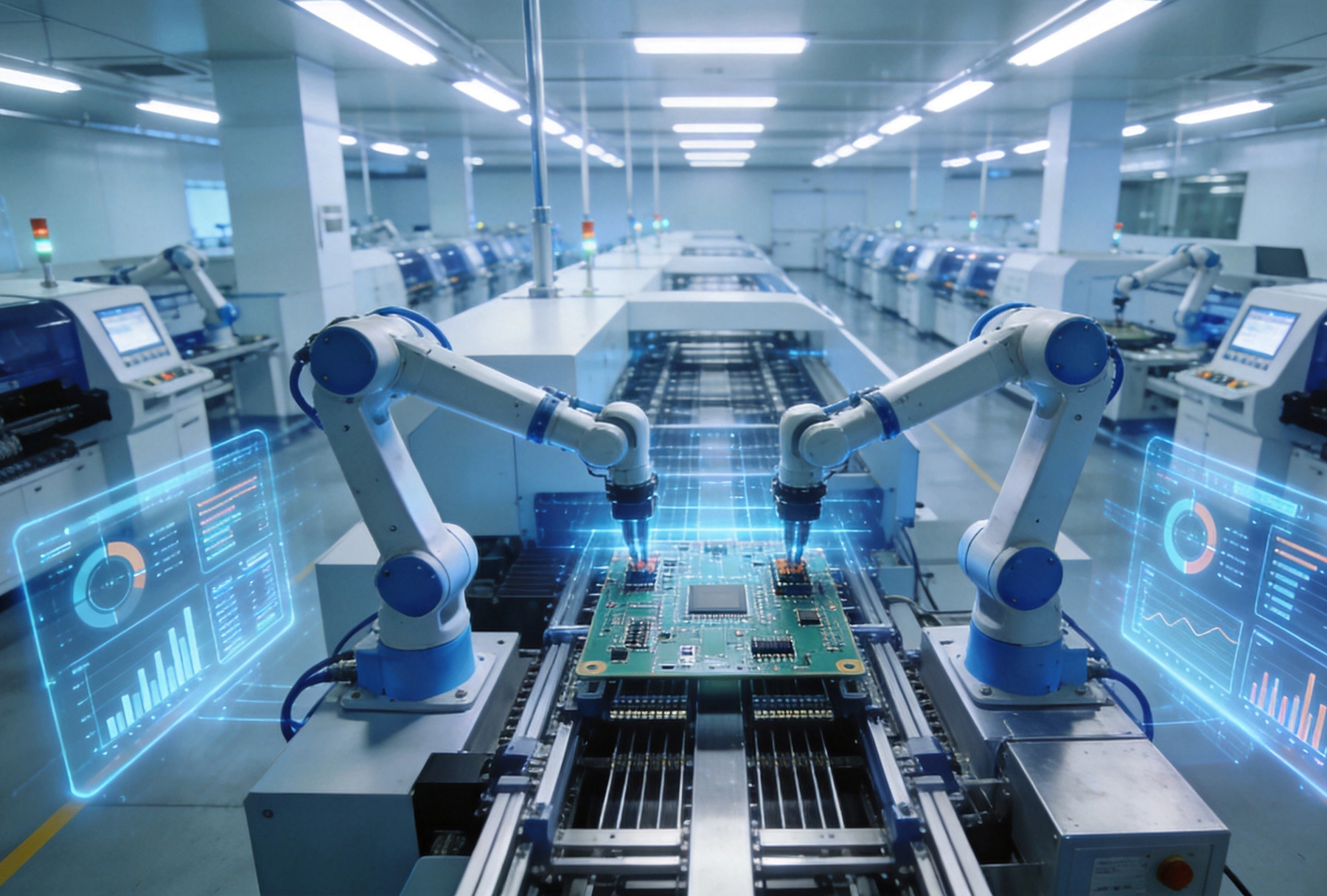
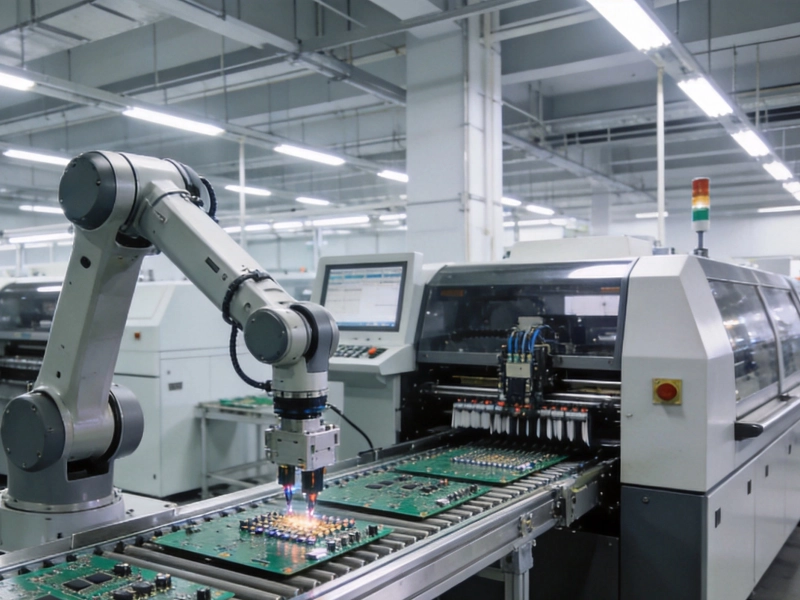
A smart factory in the PCB assembly context is more than just a facility with automated equipment. Automation has been present on SMT lines for decades—pick-and-place machines, reflow ovens, and AOI systems have long operated with minimal human intervention. What distinguishes a truely smart factory is connectivity, data intelligence, and adaptive decision-making.
In a smart PCBA factory, every machine, every conveyor, every material storage unit, and every inspection station is a node on a network. They continuously generate data—and more importantly, they consume data from each other to optimize their own operation. The pick-and-place machine knows the moisture sensitivity level of the next reel because the warehouse management system told it. The reflow oven adjusts its profile based on real-time thermocouple feedback from the board itself. The AOI system flags a defect pattern and automatically notifies the stencil printer to check its alignment. This is the essence of digital transformation: information flows where it is needed, when it is needed, without human bottlenecks.
The digital transformation of PCBA lines rests on several interconnected technology pillars. Understanding each one—and how they work together—is essential for any manufacturer planning their smart factory journey.
Internet of Things sensors are the nervous system of the smart factory. On a PCBA line, IoT devices monitor parameters that were previously invisible or only checked periodically:
The value of IIoT is not in any single sensor but in the network effect. When data from hundreds of sensors flows into a unified platform, correlations emerge that no individual measurement could reveal. A slight increase in workshop humidity combined with a minor drop in reflow zone 3 temperature might predict a spike in voiding—hours before the X-ray inspector sees it themsleves.
Traditional MES systems were essentially digital record-keepers—they tracked work orders, recorded machine states, and stored inspection results. The next-generation MES is a decision engine. Connected to IoT sensor networks and fed by AI analytics, modern MES platforms can:
For PCBA operations running high-mix production, an intelligent MES is particularly valuable. It can manage changeover sequences to minimize setup time, track unique process parameters for each product variant, and ensure that first-article inspection requirements are automatically enforced at the correct point in the production flow.
Perhaps the most transformative application of digital technology in PCBA is the use of artificial intelligence for quality control. Traditional AOI and AXI systems rely on rule-based algorithms—threshold values, geometric templates, and heuristic rules defined by engineers. These work reasonably well but have well-known limitations: high false-call rates (flagging good joints as defects) and escape rates (missing genuine defects), especially on complex boards with dense component layouts.
Machine learning models trained on thousands of labeled inspection images can dramatically improve both metrics. A convolutional neural network (CNN) trained on actual defect data from your production line learns to recognize subtle patterns that rule-based systems miss—a slightly off-gray solder fillet that indicates a cold joint, or a micro-crack pattern at the component edge that signals tombstoning risk.
The key advantage of AI-based inspection is continuous improvement. As the model ingests more data—both confirmed defects and verified good joints—its accuracy improves. Some PCBA facilities report reducing AOI false-call rates from 30% to under 5% after deploying ML-augmented inspection, which translates directly to reduced operator verification labor and faster line throughput.
Beyond inspection, AI is increasingly used for predictive defect analytics. By correlating process parameters (paste volume, reflow profile, placement accuracy, environmental conditions) with downstream defect outcomes, ML models can predict which boards are most likely to fail inspection before they even reach the AOI station. This enables selective inspection—focusing human and X-ray resources on high-risk boards while letting low-risk boards flow through with lighter checks.
A digital twin is a virtual replica of a physical production line—or an individual machine, or even a specific PCB design—that mirrors its real-world counterpart in real time. For PCBA, digital twins serve several powerful purposes:
Digital twin implementation in PCBA is still maturing, but early adopters—particularly in automotive and aerospace electronics where NPI costs are high and process qualification is rigorous—are reporting significant reductions in time-to-production and first-pass yield improvements.
None of the technologies described above work in isolation, and none work without a robust data infrastructure. The digital transformation of a PCBA line requires careful attention to how data is collected, transported, stored, and consumed.
Not all data processing belongs in the cloud. On a PCBA line, some decisions must be made in milliseconds—adjusting a pick-and-place nozzle's vacuum level, for example, or triggering a conveyor diverter to route a flagged board to the rework station. Edge computing devices—industrial PCs or dedicated appliances located on the production floor—handle these latency-sensitive tasks locally.
Cloud computing, conversely, is ideal for tasks that require large-scale data aggregation and heavy computation: training machine learning models on months of inspection data, running digital twin simulations, or performing cross-factory benchmarking across multiple production sites. The most effective smart factory architectures use a hybrid approach, with edge devices handling real-time control and cloud platforms providing analytical depth.
The PCBA industry has historically suffered from equipment vendor lock-in. Each pick-and-place machine, each inspection system, each reflow oven speaks its own proprietary data language. Digital transformation demands interoperability.
The IPC-CFX (Connected Factory Exchange) standard is the industry's answer to this challenge. Based on the MQTT messaging protocol, IPC-CFX defines a common data format and communication standard for PCB assembly equipment. When machines speak CFX, any authorized system on the network can consume their data without custom integration work. A single MES can receive placement events from a Yamaha machine, print status from a DEK stencil printer, and reflow data from a Heller oven—all through the same standardized interface.
Adopting IPC-CFX is not merely a technical decision—it is a strategic one. Manufacturers who invest in CFX-compliant infrastructure gain the flexibility to mix equipment from diferent vendors, swap machines without re-integrating their data flows, and progressively add smart capabilities without rebuilding their entire data architecture.
The business case for digital transformation is built on measurable outcomes. Here is what PCBA manufacturers are actually achieving with smart factory technologies:
By connecting SPI data to downstream AOI results, smart lines can identify and correct print defects before they propagate through reflow. Facilities deploying closed-loop print-inspection feedback report first-pass yield improvements of 3–8 percentage points, which on a high-volume automotive line can represent hundreds of thousands of dollars in annual rework cost avoidance.
Predictive maintenance is one of the highest-ROI applications of IIoT data. Monitoring spindle vibration on pick-and-place machines, heater element resistance in reflow ovens, and camera calibration drift on AOI systems enables maintenance teams to address degradation before it causes a line stop. Smart PCBA facilities routinely report 20–40% reductions in unplanned downtime compared to traditional preventive maintenance schedules.
For high-mix operations, changeover time is the single largest determinant of line utilization. Smart factory systems accelerate changeovers through automated feeder setup validation, recipe management with version control, and digital first-article verification that replaces manual measurement with automated program-to-actual comparison. Changeover times of 30–45 minutes can be compressed to 10–15 minutes with fully digital changeover workflows.
Full digital traceability—knowing exactly which solder paste lot was used on which board, which reel supplied each component, and what reflow profile each board experienced—is increasingly mandatory in automotive (IATF 16949), medical (ISO 13485), and aerospace (AS9100) manufacturing. Smart factory platforms make this traceability automatic rather than dependent on operator discipline with paper travelers or barcode scans.
Digital transformation is not an all-or-nothing proposition. Attempting to convert a traditional PCBA line into a fully smart factory overnight is a recipe for failure. A phased approach is both more practical and more likely to deliver returns at each stage.
The first step is making existing equipment data visible. Install network connections on all production machines, implement an MES if one is not already in place, and deploy dashboards that show real-time production status, machine utilization, and defect trends. This phase alone—often achievable in 3–6 months—delivers significant value by replacing reactive management with data-informed decision-making.
With data flowing, the next phase adds intelligence. Deploy SPC (Statistical Process Control) with automated alarming, implement predictive maintenance models for critical equipment, and begin experimenting with ML-based AOI optimization. This phase typically requires 6–12 months and demands investment in data science talent or partnerships with analytics vendors who understand PCBA processes.
The final phase closes the loop: systems not only detect and predict but automatically act. Closed-loop print-to-inspection feedback, autonomous changeover sequencing, dynamic line balancing, and self-optimizing reflow profiles represent the full realization of smart factory principles. Reaching this phase is a 12–24 month journey from Phase 2, and not every manufacturer needs or wants full autonomy—some processes benefit more from decision support than full automation.
The path to a smart PCBA factory is not without obstacles. Being aware of these challenges helps manufacturers navigate them successfully:
Digital transformation in PCBA is a capital-intensive undertaking, and manufacturing executives rightly demand clear ROI projections. While the specific payback varies by operation, the following framework helps quantify the investment:
Most PCBA manufacturers report achieving positive ROI on their smart factory investments within 18–30 months for the foundational Phase 1 and Phase 2 capabilities. Phase 3 automation delivers incremental returns that depend heavily on the specific production mix and volume.
The digital transformation of PCBA production lines is not a question of if but of when and how. The competitive advantages—higher yields, lower downtime, faster changeovers, full traceability, and data-driven quality—are too significant to ignore. While the journey from a traditional line to a smart factory requires substantial investment in technology, process redesign, and workforce development, a phased approach allows manufacturers to capture value at each stage and build their capabilities progressively.
The manufacturers who will lead the next decade of PCBA production are those who treat data as a strategic asset, invest in interoperable infrastructure, and cultivate the organizational culture needed to turn digital capabilities into operational excellence. The smart factory is not just about technology—it is about reimagining how electronics manufacturing works when information flows as freely as the boards on the conveyor.
For companies seeking a PCBA partner that has already invested in smart factory infrastructure—with IPC-CFX connectivity, AI-augmented inspection, and full digital traceability—working with a forward-thinking PCBA manufacturer can provide access to these capabilities without the capital investment of building them in-house.
Automation refers to machines performing tasks without direct human control—pick-and-place machines and reflow ovens have been automated for decades. A smart factory adds connectivity, data intelligence, and adaptive decision-making. In a smart factory, machines communicate with each other, AI systems analyze data to predict and prevent problems, and processes adjust themselves based on real-time conditions. Automation executes; a smart factory executes, monitors, learns, and optimizes.
Costs vary widely depending on the starting point and scope. A basic Phase 1 implementation (MES, dashboards, basic connectivity) for a single SMT line might range from $100,000 to $300,000. Adding AI analytics and predictive maintenance (Phase 2) can add $200,000 to $500,000. Full Phase 3 autonomous operation represents a multi-year, multi-million dollar investment for a complete facility. However, each phase delivers independent ROI.
Adoption is growing but not yet universal. Major equipment vendors including Koh Young, Viscom, and Saki support CFX for inspection equipment. Among placement and printing equipment vendors, adoption is increasing but many still rely on proprietary protocols. The IPC is actively promoting CFX adoption, and manufacturers should insist on CFX support in new equipment purchases to drive the ecosystem forward.
Absolutly. While the full smart factory vision is often associated with large-scale operations, even small PCBA shops benefit from basic digital capabilities: an MES for traceability, automated SPC for process control, and data dashboards for production visibility. Cloud-based SaaS platforms make these capabilities accessible without large upfront capital investments, and the ROI from even basic digital traceability and yield tracking can be compelling for smaller operations.
The primary risks include ransomware attacks that could halt production, unauthorized access to process data that could compromise intellectual property, and manipulation of machine parameters that could introduce defective products. Mitigation requires implementing IEC 62443 industrial cybersecurity standards, network segmentation between IT and OT systems, regular vulnerability assessments, and employee training on social engineering threats. Cybersecurity must be architected into the smart factory from day one, not added as an afterthought.
Behind the Scenes: A Tour of Our Advanced SMT Assembly FacilityAugust/07/2026
The Role of Low Volume Assembly in Aerospace and DefenseJuly/21/2026
The Future of Flexible Hybrid Electronics (FHE) in AssemblyAugust/06/2026
Streamlining Production with Integrated PCB Fabrication and AssemblyJuly/20/2026
Reflow Soldering Profiles Explained: Avoiding Thermal DefectsJuly/01/2026