Open Nav



Electrostatic discharge is the silent killer of electronic assemblies, responsible for up to 30 percent of all field failures in consumer, industrial, and medical electronics, costing the global electronics industry more than $5 billion annually in rework, warranty claims, and lost revenue. A static discharge of just 1,000 volts — far below the 3,000 volt threshold that humans can feel — can permanently damage sensitive CMOS microcontrollers, RF transceivers, and high-speed semiconductor components, often with no visible sign of damage that would be caught during standard functional testing. The damage may lie dormant for months, then cause an unexpected failure in the field long after the product has been shipped to the customer. Proper ESD protection during PCB assembly is not an optional quality add-on; it is a fundamental requirement for building reliable electronics, and it demands a facility-wide, system-level approach rather than just requiring workers to wear wrist straps. Our assembly facility implements a rigorous, ANSI/ESD S20.20 certified ESD control program that eliminates static damage risk at every step of the assembly process, from component receiving through finished goods testing and packaging.
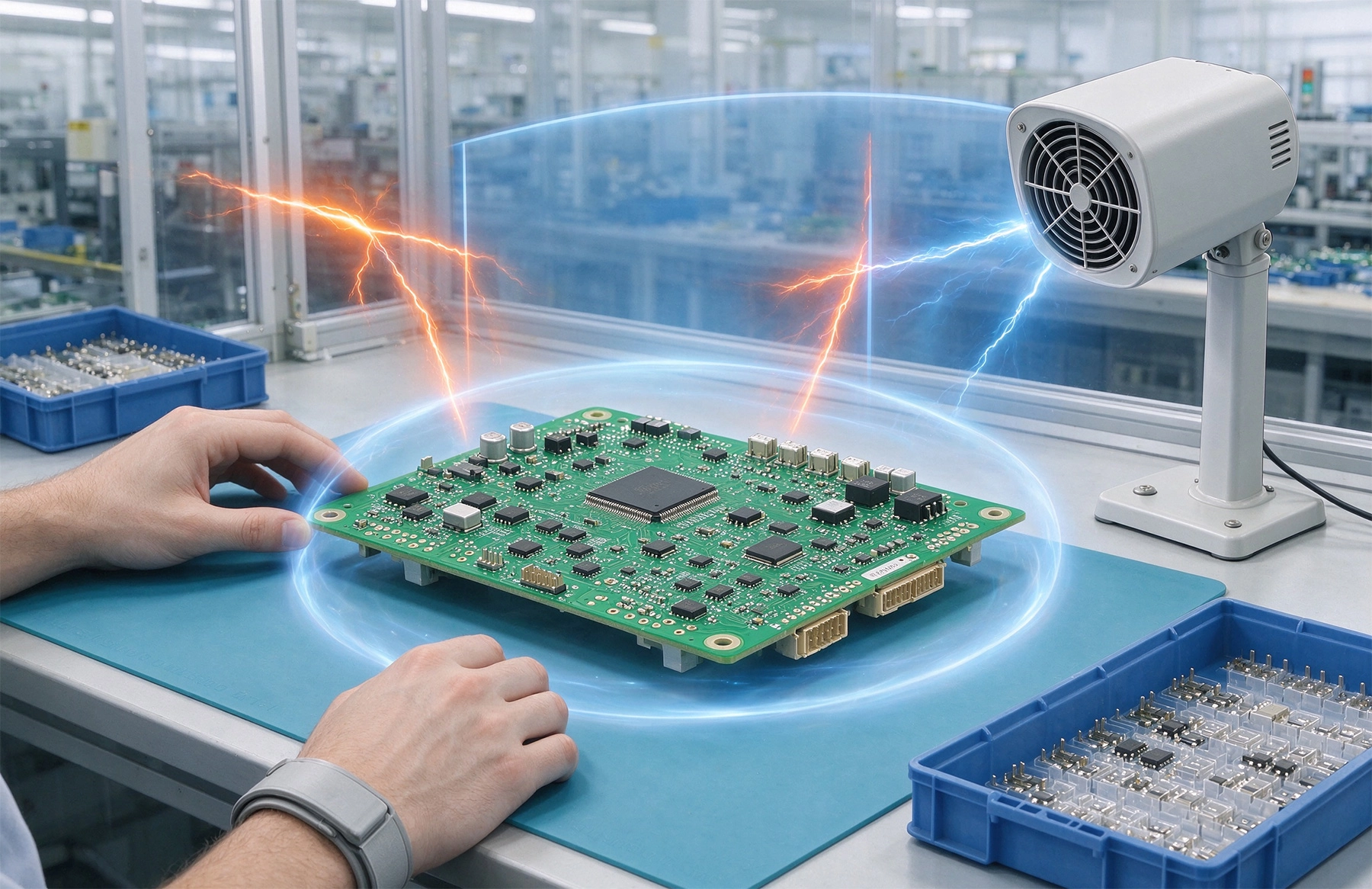
The foundation of our ESD protection program is our fully controlled ESD Protected Area, where all PCB assembly operations take place. The entire assembly floor is designed as a continuous EPA, with strict access controls and facility-wide static mitigation measures that eliminate the possibility of static charge buildup before it can cause damage.
Conductive ESD flooring covers 100 percent of the assembly area, with a measured resistance to ground of 1 x 10^6 to 1 x 10^9 ohms, which dissipates static charges from footwear and equipment wheels before they can build up to damaging levels. The flooring is tested quarterly with a surface resistance meter to verify performance, and any worn or damaged sections are replaced immediately. All workbenches in the assembly area are fitted with 2mm thick static-dissipative rubber matting, permanently grounded to the facility's common ESD ground point via a 1 megohm current-limiting resistor that provides safe static dissipation without creating an electrical shock hazard for workers. Each workstation has a dedicated grounded ESD wrist strap connector with continuous real-time monitoring, and a static dissipative work surface tray for holding boards and components during manual operations.
Humidity control is maintained across the entire EPA at 40 to 60 percent relative humidity 24 hours a day, 7 days a week. Low humidity levels below 30 percent drastically increase the likelihood of static charge buildup on surfaces and personnel, so our HVAC system automatically adjusts humidity levels to stay within the optimal range, even during dry winter months. Air ionizers are installed above every SMT placement line and rework station to neutralize static charges on insulating materials that cannot be grounded directly, like plastic component reels and PCB substrate materials. The ionizers are tested monthly with an electrostatic field meter to verify they maintain a ±50 volt ion balance across the work surface.
Access to the EPA is restricted to trained personnel only. All visitors are required to wear ESD-safe visitor smocks and heel straps, and are escorted by a trained employee at all times. No non-ESD safe materials are allowed inside the EPA, including plastic bags, regular paper, foam packaging, and synthetic clothing that generates high levels of static charge. All tools and equipment used inside the EPA, including tweezers, soldering irons, flux dispensers, and test probes, are certified ESD-safe by the manufacturer and tested quarterly for grounding integrity.
Even the best facility ESD controls are useless if personnel do not follow proper personal protective equipment protocols. Every employee working in the EPA is required to complete a 4-hour ESD training program on hire, with annual refreshers and quarterly spot checks to verify compliance with all protocols.
All personnel working at seated workstations are required to wear a properly fitted ESD wrist strap at all times when handling components or assembled boards. The wrist strap makes direct contact with bare skin on the wrist or forearm, and is connected to the continuous monitoring system at the workstation that triggers an audible and visual alarm if the ground connection is broken or the resistance falls outside the acceptable range. We do not use unmonitored wrist straps, as independent studies show that 20 to 30 percent of unmonitored straps have broken connections or inadequate skin contact that renders them ineffective, with no way for the worker to know there is a problem.
Personnel working at standing workstations, including SMT line operators, test technicians, and material handlers, are required to wear ESD heel straps on both feet, which make contact with the conductive flooring to dissipate static charges as they move around the facility. The heel straps are checked daily with a wrist/heel strap tester before personnel enter the EPA, and any worn or defective straps are replaced immediately. All personnel are also required to wear ESD-safe smocks made of static-dissipative fabric that cover all personal clothing, especially synthetic materials like polyester and nylon that generate high levels of static charge. The smocks are grounded to the worker's body via the wrist or heel strap, ensuring any charge buildup on the smock is safely dissipated to ground.
All personnel are trained to handle bare boards and components by the edges only, never touching component leads, pins, or exposed copper traces directly with their fingers. They are also trained to never place a bare board on any surface that is not ESD-safe, and to always transport boards in sealed ESD shielding bags or static-dissipative trays. Non-compliance with ESD protocols is treated as a serious safety violation, with progressive disciplinary action for repeated offenses, because even a single instance of improper handling can cause widespread damage to a production run.
ESD protection starts long before components reach the assembly line, beginning at the receiving dock where all incoming parts are inspected and stored in ESD-safe conditions until they are needed for production.
All static-sensitive components, including microcontrollers, memory chips, RF semiconductors, and high-speed integrated circuits, are shipped from suppliers in ESD shielding bags or conductive trays, and are never opened outside the EPA. Our receiving team inspects all incoming component packaging for ESD shielding certification and any signs of damage that would indicate the components may have been exposed to static discharge during shipping. Any components received in non-ESD safe packaging are quarantined for 100 percent electrical testing before being released to production, to ensure no damage occurred during transit.
All components are stored in static-dissipative bins and racks in our climate-controlled component storage room, which is also part of the controlled EPA. Component reels for SMT placement are stored on conductive reel racks that are grounded to the facility ESD ground, while loose components are stored in labeled ESD-safe bins. No components are ever stored in regular plastic bags or non-conductive containers, even for short periods. When components are issued to the production line, they are transported in sealed ESD shielding bags or on conductive carts with grounded shelves, to prevent static charge buildup during transport.
During line setup, SMT feeders are loaded with component reels only inside the EPA, by trained operators wearing proper ESD PPE. All feeders are certified ESD-safe, with conductive surfaces that dissipate static charge as components are picked from the reel. Tape and reel cover tape is removed slowly to minimize static generation, and discarded cover tape is placed in dedicated static-dissipative waste bins inside the EPA. We never use compressed air to blow dust or debris off components or boards, as the air flow can generate extremely high static charge levels that damage sensitive components.
Every step of the assembly process, from solder paste printing through final test and packaging, includes dedicated ESD control measures to eliminate static discharge risk at every stage of production.
All SMT placement machines, reflow ovens, screen printers, and automated optical inspection equipment are permanently grounded to the facility's common ESD ground point, with ground resistance tested annually to ensure a solid connection. The nozzles and feeders on the placement machines are made of static-dissipative materials that prevent static charge buildup as components are picked and placed onto the board. Any boards removed from the line for inspection or rework are immediately placed in a static-dissipative tray, never set directly on a workbench or machine surface.
All hand soldering and rework stations are equipped with grounded, ESD-safe soldering irons with tip resistance to ground below 2 ohms, to prevent static discharge from the iron tip to sensitive components. The soldering iron temperature is controlled to avoid overheating components, and all rework technicians wear continuously monitored wrist straps and static-dissipative finger cots when handling boards during rework. Any residual solder or flux is cleaned off with ESD-safe cleaning swabs and isopropyl alcohol, never with regular paper towels or non-conductive wipes that generate static.
In-circuit test and functional test stations are fully grounded, with ESD-safe test fixtures and probes that do not generate static charge during contact with the board. All test operators wear continuously monitored wrist straps, and boards are only placed on static-dissipative work surfaces during testing. Any boards that fail test are placed in labeled ESD shielding bags for further analysis, to avoid exposing them to additional static damage during troubleshooting.
Finished boards are packaged for shipping in ESD shielding bags or conductive foam, depending on the application. The packaging is sealed with ESD-safe tape, and labeled with the standard ESD protective symbol to indicate that the contents are static-sensitive and should only be opened in an ESD protected area. We never use bubble wrap, styrofoam, or other non-ESD safe packaging materials for finished boards, as these can generate high levels of static charge during shipping that damages the assembled product before it reaches the customer.
Our ESD control program is not a one-time implementation; it is continuously monitored, audited, and improved to maintain compliance with the latest ANSI/ESD S20.20 standards and to adapt to new process requirements as we introduce new technologies and component types.
Real-time ESD monitoring systems at every workstation log all wrist strap connection events and alarm conditions, so we can identify patterns of non-compliance or equipment issues before they lead to product damage. The monitoring data is reviewed weekly by our quality team to identify any training gaps or process issues that need to be addressed. We also perform daily spot checks of workstations using an electrostatic field meter to verify that static voltage levels on all work surfaces remain below 100 volts, which is the maximum safe level for handling even the most sensitive components.
Quarterly internal ESD audits cover every aspect of the program, including flooring resistance, work surface resistance, wrist and heel strap performance, ionizer balance, humidity levels, personnel training records, and process compliance. Any non-conformances identified during the audit are documented with corrective actions and completion deadlines, with follow-up verification to ensure the issue has been fully resolved. We also conduct annual third-party ESD certification audits to verify our program meets all ANSI/ESD S20.20 requirements, with the certification results available to customers upon request.
If ESD damage is suspected in any production run or field return, we initiate a formal root cause analysis to identify the source of the discharge. We review ESD monitoring logs from the relevant production period, audit the workstations involved, interview personnel, and test for any process deviations that may have allowed a static discharge event to occur. Once the root cause is identified, we implement corrective actions immediately, whether that means retraining personnel, replacing worn ESD equipment, adjusting process procedures, or upgrading facility controls, to prevent the same issue from recurring in the future.
Effective ESD protection during PCB assembly is a system-level discipline that requires consistent implementation across every aspect of facility design, personnel training, process control, and continuous monitoring. A single weak point in the system — an ungrounded soldering iron, a wrist strap that is not monitored, or a component opened outside the EPA — can cause widespread damage that leads to costly field failures and damaged customer trust. Our certified ESD control program eliminates these risks, ensuring that every assembly we produce is protected from static damage throughout the entire manufacturing process, resulting in field failure rates 70 percent lower than the industry average for high-complexity electronic assemblies. Investing in rigorous ESD protection is not an added cost; it is an investment in product reliability that pays for itself many times over in reduced rework, lower warranty costs, and higher customer satisfaction.
Contact us to discuss your PCB assembly requirements and to explore how our certified ESD control program can deliver reliable, high-quality assembly for your sensitive electronic products.

Why Communication is Key in Successful Turnkey ProjectsJuly/25/2026

How to Evaluate a Reliable Prototype PCB Assembly PartnerJuly/29/2026

How to Prepare the Perfect BOM (Bill of Materials) for Turnkey Assembly?July/17/2026
FAQ: Can You Assemble Boards with Components on Both Sides?July/22/2026

High-Mix Low-Volume (HMLV) Manufacturing: Is Your Supplier Ready?October/12/2026