Open Nav



Surface finish selection is one of the most consequential decisions in PCB design. The finish you choose directly affects solderability, shelf life, component compatibility, and long-term reliability of your assembled boards. Yet many engineers treat surface finish as an afterthought, defaulting to whatever the manufacturer recommends or whatever appears cheapest on the quote.
This approach leads to problems downstream. A finish that works perfectly for one application may cause field failures in another. A board assembled with the wrong surface treatment can experience poor solder joints, delamination during reflow, or premature corrosion in service. Understanding the trade-offs between finish types helps you make informed decisions that balance performance requirements against cost constraints.
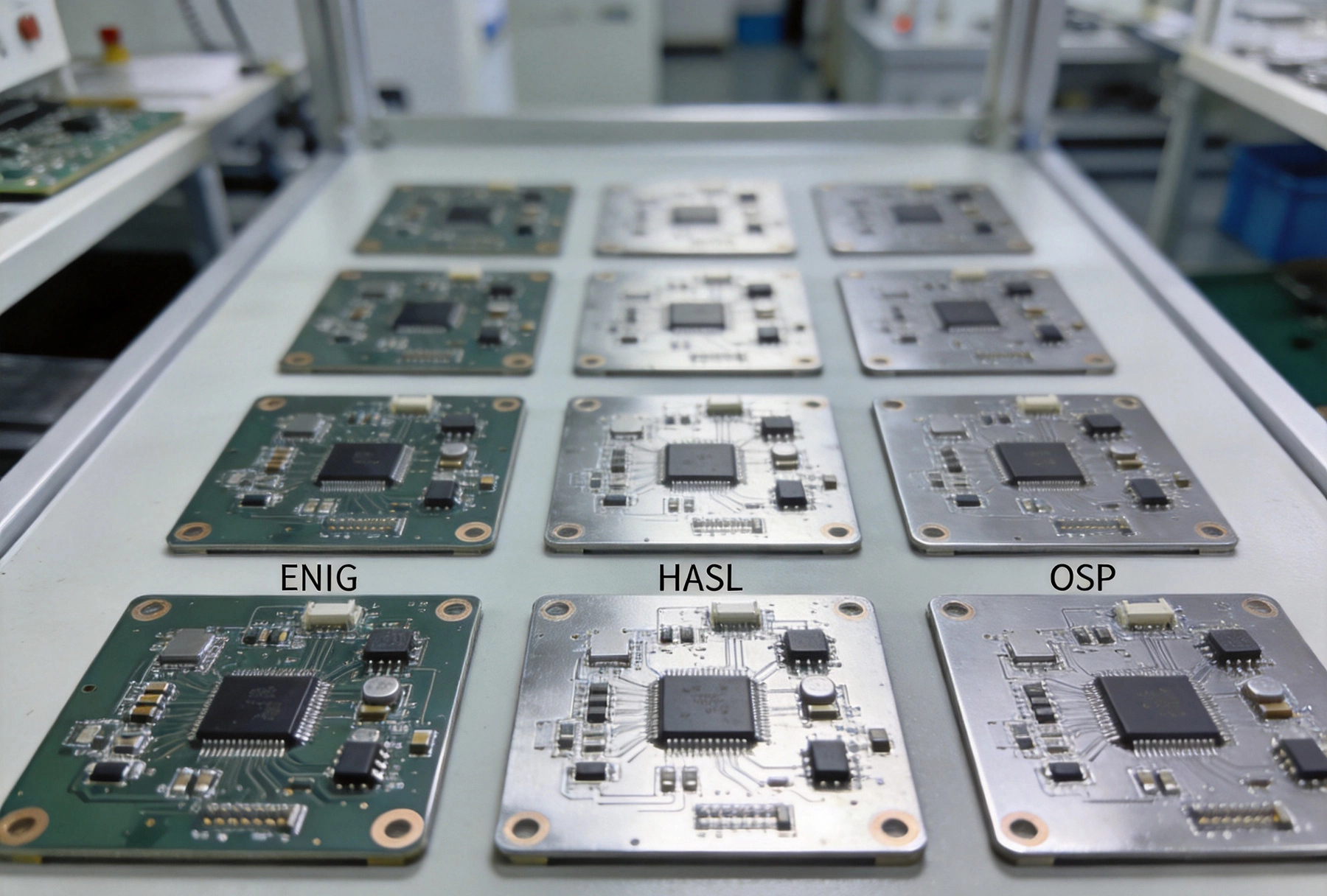
Before comparing finish types, it helps to understand what surface finish accomplishes. The copper traces and pads on a bare PCB oxidize rapidly when exposed to air. Copper oxide prevents solder from wetting properly during assembly, creating weak joints or complete assembly failures. Surface finish serves two primary purposes: protecting copper from oxidation and providing a solderable surface for component attachment.
The ideal surface finish would be inexpensive, provide excellent solderability, have unlimited shelf life, and create reliable joints that survive decades of service. In reality, each finish type represents a different balance of these characteristics. Some finishes excel in certain applications while failing in others. Your job is to match the finish characteristics to your specific requirements.
ENIG applies a thin layer of gold over electroless nickel to protect copper traces and pads. The nickel provides a diffusion barrier that prevents copper from migrating into the gold, while the gold protects the nickel from oxidation and provides an excellent solderable surface. This finish has become the default choice for most high-reliability applications, particularly those with fine-pitch components like BGA and QFN packages.
The advantages of ENIG include excellent flatness (critical for fine-pitch assembly), good shelf life measured in months, and superior wire bonding capability for applications requiring internal connections. The gold surface also resists oxidation effectively, maintaining solderability even after extended storage. These benefits come at a cost premium compared to basic finishes, and the process requires careful control to avoid defects like black pad syndrome.
ENIG works well for high-density assemblies with fine-pitch components, applications requiring multiple reflow cycles, boards that need wire bonding or edge plating, and products expected to operate for extended periods in challenging environments.
HASL applies solder to exposed copper by dipping boards in molten solder and then leveling the surface with hot air blades. This traditional finish has been used for decades and remains common due to its low cost and excellent solderability. The process naturally planarizes the board surface, filling minor irregularities and creating a relatively flat finish suitable for through-hole components.
Modern HASL uses lead-free solder compositions (typically tin-copper or tin-silver-copper alloys) to comply with RoHS requirements. The resulting surface is durable, has excellent shelf life, and solders readily with most assembly processes. The primary drawback is surface unevenness caused by the dipping process. HASL surfaces exhibit some coplanarity variation that can cause problems with very fine-pitch components.
HASL suits applications with primarily through-hole components, boards with larger pitch components where surface flatness is less critical, cost-sensitive projects where budget constraints outweigh advanced performance needs, and prototype runs where quick turnaround and low cost take priority.
OSP applies a thin organic coating that bonds to copper surfaces and protects against oxidation. The coating is water-based and environmentally friendly, making it popular for applications concerned with chemical exposure and disposal. OSP provides excellent coplanarity since it adds essentially no thickness to the copper surface.
The main limitation of OSP is shelf life. Unlike metallic finishes that protect copper for extended periods, OSP coatings degrade over weeks to months depending on storage conditions. Boards treated with OSP should be assembled promptly after receipt. OSP also does not tolerate multiple reflow cycles well, making it unsuitable for assemblies requiring step soldering or repeated thermal exposure.
OSP works best for single-sided assemblies with standard pitch components, applications where environmental concerns drive material selection, prototypes and low-volume production runs, and boards that will be assembled quickly after receipt from the manufacturer.
Immersion silver deposits a thin silver layer directly onto copper through a chemical displacement reaction. The resulting surface is very flat, provides excellent solderability, and maintains reflectivity that helps with optical inspection. Silver surfaces also offer good electrical conductivity, making this finish popular for high-frequency applications where signal integrity matters.
Immersion silver has moderate shelf life, typically several months when stored properly. The main vulnerability is silver migration, where silver atoms diffuse into adjacent materials or create conductive paths across the board surface under certain conditions. Silver also tarnishes when exposed to sulfur-containing environments, though this typically does not affect solderability. Proper packaging and storage extend shelf life significantly.
Immersion silver suits high-frequency applications where surface flatness impacts performance, boards requiring fine-pitch components with good coplanarity, LED lighting applications where reflectivity helps with inspection, and mixed-signal products benefiting from silver's conductivity characteristics.
Immersion tin deposits a thin tin layer over copper, providing good solderability with relatively low cost. The finish creates a uniform, flat surface suitable for most component types. Tin surfaces are susceptible to whisker formation over time, though modern processing has reduced this problem significantly.
One consideration with immersion tin is sensitivity to handling. The thin tin layer can be damaged by excessive contact or improper storage. Multiple reflow cycles may also degrade solderability, limiting this finish's suitability for complex assemblies with many thermal steps. Like other immersion finishes, shelf life is measured in months rather than years.
Immersion tin works for standard SMT assemblies with moderate complexity, cost-sensitive applications requiring good coplanarity, and boards that will be assembled within a reasonable timeframe after manufacture.
Fine-pitch components with small lead spacing require flat surfaces to ensure reliable solder joint formation. BGA packages, QFN components, and fine-pitch SOICs perform best with ENIG or immersion silver finishes that maintain tight coplanarity tolerances. Standard-pitch SOICs, TSSOP packages, and larger components tolerate more surface variation and work well with HASL or OSP.
Through-hole components benefit from HASL, which naturally fills holes and creates good solder fillets. The planarization effect of HASL also helps with wave soldering processes where components are mounted on the bottom side of the board.
Assemblies requiring multiple reflow cycles need finishes that maintain solderability through repeated thermal exposure. ENIG handles thermal cycling well, with the nickel barrier protecting the underlying copper throughout multiple passes. OSP degrades with each thermal cycle and works best for single-reflow assemblies. HASL tolerates multiple cycles reasonably well, though surface appearance may change with each pass.
Assemblies using selective soldering for through-hole components benefit from finishes that withstand localized heating without degradation. ENIG and immersion silver perform well in selective processes, while OSP may require careful process control to avoid coating damage in heated areas.
Products deployed in harsh environments face challenges that affect surface finish selection. High humidity accelerates oxidation of unprotected surfaces and can degrade OSP coatings faster than controlled conditions. Elevated temperatures may cause finish degradation or intermetallic compound growth that affects long-term reliability. Chemical exposure in industrial settings can attack certain finishes.
For outdoor or automotive applications, ENIG's robust nickel barrier provides the best protection against environmental degradation. Immersion silver offers good performance in moderate environments but may tarnish in sulfur-rich atmospheres. OSP requires sealed packaging and controlled storage to maintain performance in challenging deployments.
Consider your supply chain when selecting surface finish. If you order boards and store them before assembly, OSP's limited shelf life creates risk. Boards sitting in inventory for months may have degraded solderability when you finally attempt assembly. ENIG and HASL tolerate extended storage, with ENIG offering the longest effective shelf life under normal conditions.
For just-in-time manufacturing with rapid assembly after board receipt, OSP becomes viable since boards reach assembly before degradation becomes significant. For longer supply chains with uncertain assembly timing, metallic finishes provide insurance against storage-related problems.
Surface finish pricing varies significantly across options, with ENIG commanding the highest cost and HASL representing the most economical choice. OSP and immersion silver fall in the middle range, offering good performance without ENIG's premium pricing. For high-volume production, finish cost becomes a significant factor in overall product economics.
Balance finish cost against failure costs. A field failure due to improper finish selection costs far more than the price difference between finish options. Similarly, assembly rework caused by poor solderability adds expenses that may exceed finish cost savings. Consider total cost of ownership rather than just material cost when making finish decisions.
Consumer products typically prioritize cost over extreme reliability, making HASL a common choice for standard assemblies. When consumer products include fine-pitch components or face competitive pressure for high reliability, ENIG provides a reasonable upgrade path. The balance between cost and performance depends on product positioning and expected service life.
Industrial applications demand reliable operation over extended periods, often in challenging environments. ENIG provides the durability and consistency that industrial applications require, particularly for boards with mixed technologies or fine-pitch components. The higher initial cost of ENIG reduces through-life support costs by preventing assembly and field failures.
Medical electronics must meet strict reliability requirements since failures may affect patient safety. ENIG is the standard choice for medical applications, providing the flat surface needed for fine-pitch components and the durability required for long-term implantation or diagnostic use. Documented process control and traceability requirements often mandate specific finish types for regulatory compliance.
Automotive applications require finishes that survive thermal cycling, vibration, and environmental exposure over vehicle service life. ENIG handles automotive requirements well, though some manufacturers specify specific finish compositions or thicknesses to meet automotive reliability standards. TheAutomotive Electronics Council standards define testing requirements that inform finish selection for automotive products.
Telecom equipment operates continuously and must maintain reliability over decades of service. High-frequency telecom applications also benefit from flat surfaces that minimize signal distortion. ENIG or immersion silver suit telecom requirements, with silver offering advantages for high-frequency signal integrity in RF and microwave applications.
The cheapest finish often costs more in the long run when assembly yields drop or field failures occur. Evaluate finish selection based on total cost including potential rework, warranty claims, and customer satisfaction impacts. A few cents saved per board means nothing if the resulting product fails prematurely.
Fine-pitch BGAs and QFNs require flat surfaces. Specifying HASL or OSP for assemblies with these components because they cost less creates assembly challenges and potential reliability problems. Match finish flatness to component requirements from the start of the project.
OSP boards assembled months after receipt may have degraded solderability that causes assembly failures. If your supply chain involves extended storage, specify ENIG or HASL rather than OSP to avoid surprises during assembly. Better yet, work with your manufacturer to establish appropriate shelf life limits and storage conditions.
Some finishes perform poorly in specific environments. Silver tarnishes in sulfur-rich air, affecting appearance and potentially solderability. Nickel from ENIG may cause concerns in certain medical implant applications. Evaluate your deployment environment against finish characteristics before specifying a particular treatment.
Your PCB manufacturer's process capabilities influence which finishes they can produce reliably. Not all manufacturers offer all finish options, and quality varies across suppliers. Discuss your requirements with your manufacturer early in the design process to confirm they can produce the finish you need with consistent quality.
Ask manufacturers about their process controls, testing procedures, and quality metrics for finish processes. Suppliers who monitor solderability, coating thickness, and visual characteristics provide more consistent results than those who simply apply finishes without process control. This consistency translates to more predictable assembly yields and fewer surprises during production.
Request sample boards when switching finish types or working with new manufacturers. Test sample boards through your assembly process before committing to production volumes. This verification catches problems early when they can be addressed through manufacturer communication or design changes rather than expensive production rework.
Surface finish can usually be changed on existing designs without layout modifications. However, some assembly characteristics may change. HASL produces less flat surfaces than ENIG, so fine-pitch components may behave differently. Test assemblies with the new finish before volume production to verify compatibility with your component selection.
All common surface finishes work with lead-free solders. ENIG handles lead-free reflow profiles well, with the nickel barrier maintaining integrity through higher melting point temperatures. HASL in lead-free compositions (SAC alloys) provides good results. OSP and immersion silver also perform reliably with lead-free processes when assembly parameters are optimized.
Manufacturers should provide certificates of conformance documenting finish type, coating thickness, and visual inspection results. For critical applications, request additional testing such as solderability assessments, X-ray fluorescence measurement of coating composition, or accelerated aging tests to verify shelf life claims.
Black pad occurs when the nickel surface under gold becomes oxidized, creating a non-wettable layer that prevents proper solder joint formation. This defect results from process control problems during ENIG application or from contamination before soldering. Quality manufacturers prevent black pad through proper process control and handling procedures. The problem is rare with experienced suppliers.
Surface finish selection influences assembly yields, product reliability, and through-life performance. Take time to evaluate finish options against your specific requirements rather than defaulting to familiar choices or lowest-cost alternatives. The right finish for your application depends on component types, assembly processes, storage conditions, and environmental factors. Partner with your manufacturer to confirm their process capabilities match your finish requirements, and verify new finish selections with sample assemblies before committing to production volumes.
Avoiding Tombstoning and Bridging in Your PCB LayoutJuly/30/2026
The Science of Solder Paste Printing Keys to Perfect SMT AssemblyJune/04/2026

The Future of Flexible Hybrid Electronics (FHE) in AssemblyAugust/06/2026

IoT Device Manufacturing: Speed and Efficiency in PCBAAugust/03/2026
Optimizing Component Spacing for Efficient PCB AssemblySeptember/10/2026